





Media Library
Documentary, graphic and/or audiovisual knowledge objects are offered here, offering information on various sectors and topics. Use the keyword search or search filters to access current audiovisual and documentary knowledge objects useful for your implementation.
If you have any questions or suggestions, please contact us here.
Destacados
Guide to integrated pest management for broadleaf trees
The publication of the Integrated Pest Management guidelines, agreed upon at the national level, represents a step forward in the plant health of Spanish crops and enriches the regulatory framework defined by Regulation (EC) No 1107/2009 and Directive 2009/128/EC of the European Parliament and of the Council.
Quercus Integrated Pest Management Guide
Pest management in the genus Quercus
Fire Bacterial (Erwinia amylovora)
Fire blight is a disease caused by the bacterium Erwinia amylovora (Burr) Winsl. et al., which mainly affects plants of the Rosaceae family, producing significant economic losses due to direct damage in pome fruit farms in general, and in apple and pear orchards in particular, as well as in ornamental and wild plants of this family.
Contingency Plan for Bursaphelenchus xylophilus (Steiner & Buhrer)
Bursaphelenchus xylophilus, the pine wood nematode (PWM), is a quarantine pest that causes serious damage to species of the genus Pinus sp. and other conifers.
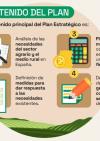
CAP strategic plan
With the reform of the CAP 2023-2027, a new approach is established whereby Member States must set out the details of the interventions or measures of the new CAP, through a strategic plan.
Practical Guidance on the Application of Traceability, Self-Control and Conditionality in the Integrated Production System of Castilla y León
The purpose of this PRACTICAL GUIDE is to recommend the minimum actions that must be implemented by entities that carry out the Integrated Production system, especially regarding the types of control to be carried out, their frequency and the sampling methodology.
Horticultural crops in Castile and León
This set of fact sheets on horticultural crops in Castile and León contains information on: Garlic. Cabbage. Onion. Endive. Asparagus. Strawberry. Green peas. Green beans. Lettuce. Pepper. Leek. Tomato. Carrot.
National Contingency Plan for Eotetranychus lewisi
This document sets out the measures to be taken against Eotetranychus lewisi, a regulated harmful organism, with the aim of preventing its emergence and, if it does, acting quickly and effectively, determining its distribution and implementing eradication measures. Eotetranychus lewisi is a mite of the Tetranychidae family.
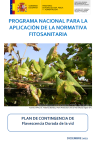
Contingency Plan for Golden Flavescence of the grapevine
This document sets out the measures to be taken against Flavescence dorée of grapevine (FD), a Union quarantine pest regulated by Regulation (EU) 2016/2031 and Regulation (EU) 2019/2072, with the aim of preventing its appearance, and, if it does appear, acting quickly and effectively, determining its distribution and combating it in order to prevent its spread and eradicate it.
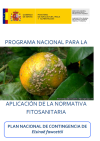
National Contingency Plan for Elsinoë fawcettii
This document outlines the measures to be taken against Elsinoë fawcettii, a regulated harmful organism, with the aim of preventing its emergence and, if it does, responding quickly and effectively, determining its distribution, and implementing eradication measures. Elsinoë fawcettii is a fungus of the Ascomycota phylum and the Elsinoaceae family that causes the disease citrus scab.
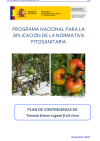
Tomato brown rugose fruit virus contingency plan
This document sets out the measures to be taken against the Tomato Brown Rugose Fruit Virus (ToBRFV) virus, with the aim of preventing its appearance and, if it does appear, acting quickly and effectively, determining its distribution and combating it in order to try to eradicate it and prevent its spread at all times.
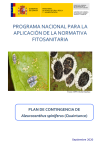
Aleurocanthus spiniferus Contingency Plan (Quaintance)
This document sets out the measures to be taken against the quarantine pest Aleurocanthus spiniferus (Quaintance), with the aim of preventing its appearance and, if it does appear, acting quickly and effectively, determining its distribution and combating it in order to try to eradicate it and prevent its spread at all times.
National Contingency Plan for Scirtothrips aurantii
This document outlines the measures to be taken against the Scirtothrips aurantii Faure insect, a quarantine pest, with the aim of preventing its appearance, and if it does appear, acting quickly and effectively, determining its distribution and combating it in order to try to eradicate it and at all times prevent its spread.
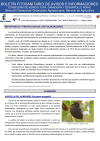
Phytosanitary bulletin of notices and information
Pollinating insects are vitally important for the proper functioning of crops. Pollination is essential to ensuring the quantity and quality of crops and food production, directly linking wild ecosystems with agricultural production systems.
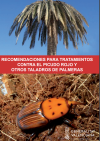
Triptych Rhynchophorus ferrugineus (Red palm weevil)
Recommendations for treatments against red palm weevil and other palm borer pests
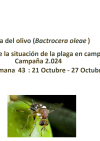
Monitoring the olive fruit fly (Bactrocera oleae)
Field Pest Situation Report, 2024 Campaign, Week 43: October 21-October 27
Olive fly (Bactrocera oleae) treatment notice
The olive fruit fly population is beginning to increase this year, so an initial bait treatment is recommended. Once the first pitted olives appear, the next generation of adults will emerge approximately 25 days later, and a second bait treatment is required to control them.
Monitoring South African Cotonet in citrus
Delottococcus aberiae has become a key pest in the fields where it is present because it causes severe damage and is difficult to control. In addition to the damage typical of other pseudococcid species, this species causes deformation and/or reduction in fruit size. Delottococcus aberiae deforms fruit from petal fall until the fruit reaches a diameter of 2–3 cm.
Monitoring Paraleyrodes minei in Persimmon
Whiteflies are among the pests of greatest concern to the persimmon production sector in the Valencian Community. Within this group of insects, the species most commonly found on persimmons are Dialeurodes citri, Paraleyrodes minei, and Aleurothrixus floccosus.
Monitoring of Dialeurodes citri in persimmon and citrus fruits.
Whiteflies are the pests that have most concerned both the persimmon and citrus production sectors in the Valencian Community in recent years. Within this group of insects, the species most commonly found are Dialeurodes citri, Paraleyrodes minei, and Aleurothrixus floccosus.